
GO!PHA’s EU Single Use Plastics Directive (SUPD) evaluation
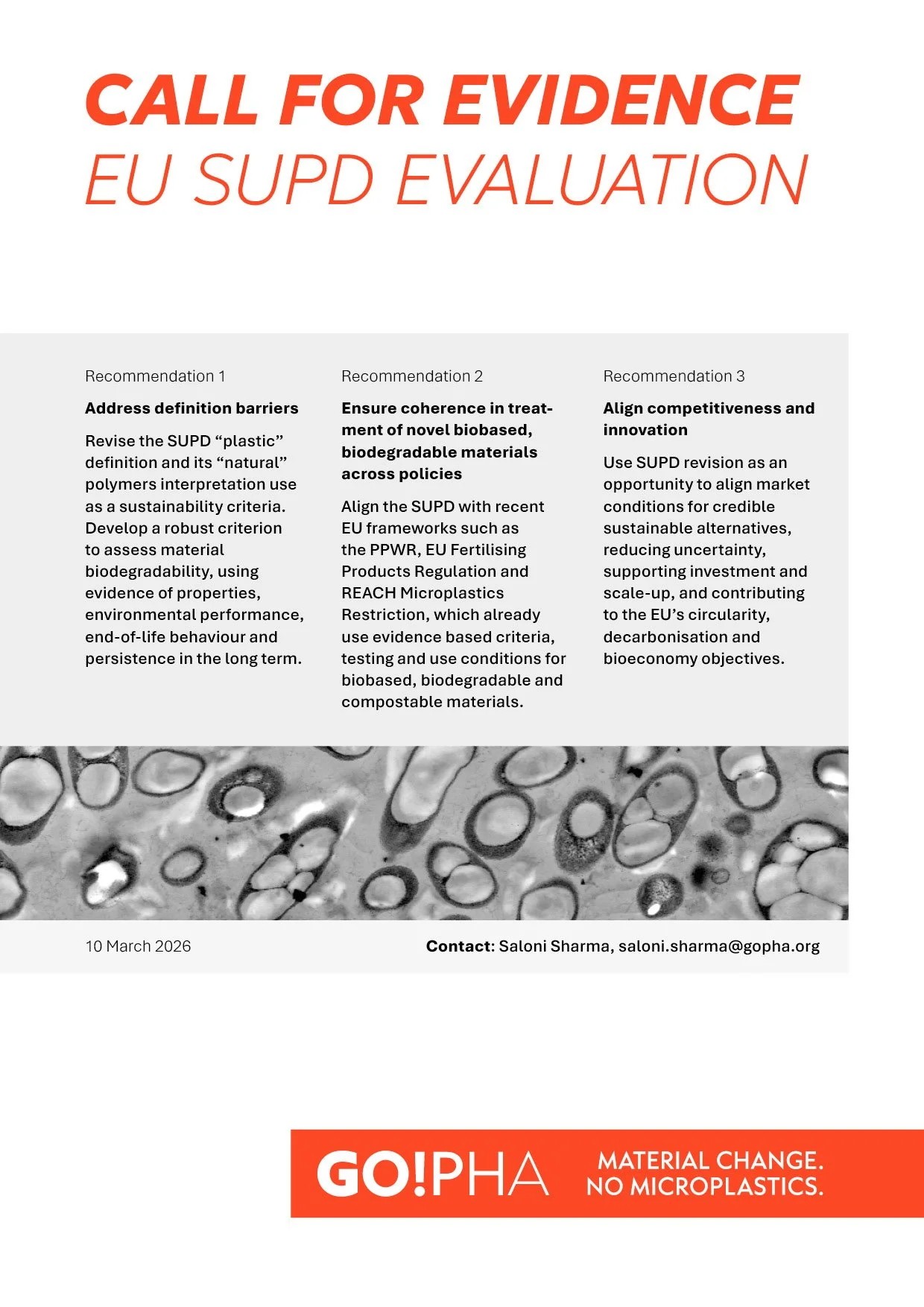
Call for evidence submission
The Single-Use Plastics Directive (SUPD) plays an important role in tackling plastic pollution and protecting ecosystems. However, the Directive’s reliance on an origin-based definition of “natural polymers” creates unintended consequences. By focusing on where a polymer is produced rather than its properties and environmental performance, the current framework discourages the adoption of industrially produced natural polymers that are identical to those found in nature. This approach creates a regulatory precedent that slows innovation, limits the deployment of sustainable materials, and introduces uncertainty for companies investing in new bio-based solutions. This is particularly unfortunate, as these materials could be a valuable asset in achieving the Directive’s environmental goals.
The brief highlights that current SUPD rules do not sufficiently account for differences in material properties, biodegradability, and environmental persistence. As a result, bio-manufactured natural polymers can be regulated in the same way as conventional plastics despite fundamentally different environmental characteristics. It also points to growing inconsistencies across EU legislation, as several newer frameworks already rely on scientific testing and performance-based criteria to assess biodegradable and bio-based materials.
The paper calls for a more science-based and coherent policy framework that recognises sustainable material innovation while maintaining strong environmental protection. Key recommendations include revising the interpretation of “natural polymers” to reflect scientific understanding, adopting a criteria-based system that evaluates materials based on properties such as biodegradability and environmental performance rather than origin, and aligning the SUPD with other EU frameworks that already use evidence-based approaches. This would help ensure the Directive supports the EU’s broader goals for circularity, decarbonisation and a competitive bioeconomy.