
EU Single Use Plastics Directive & Natural Polymers
GO!PHA contributes to the ongoing EU Single Use Plastics Directive consultation to help strengthen the Directive’s effectiveness in reducing plastic pollution. Through this process, GO!PHA provides insights on how policy measures can better support the uptake of sustainable materials, including PHA-based solutions, while ensuring the SUPD continues to drive meaningful environmental outcomes and innovation across the EU.
GO!PHA Review of Natural Polymers in Policy
Opportunities to redefine natural polymers for a competitive European Bioeconomy
GO!PHA and the nova-Institut conducted a review of how the term “natural polymers” is defined in EU policy and scientific literature. The analysis shows that while science generally considers polymers produced through biological processes, such as fermentation, to be natural when they are identical to those found in nature, current policy interpretations often focus on where polymerization occurs. This origin-based approach can create barriers for nature-identical materials and hinder innovation. The report therefore proposes three pathways to better align policy with science: revising the definition of natural polymers, adopting a criteria-based approach that evaluates materials based on environmental performance such as biodegradability, and introducing a category for “nature-identical” polymers to ensure fair regulatory treatment of bio-manufactured materials.
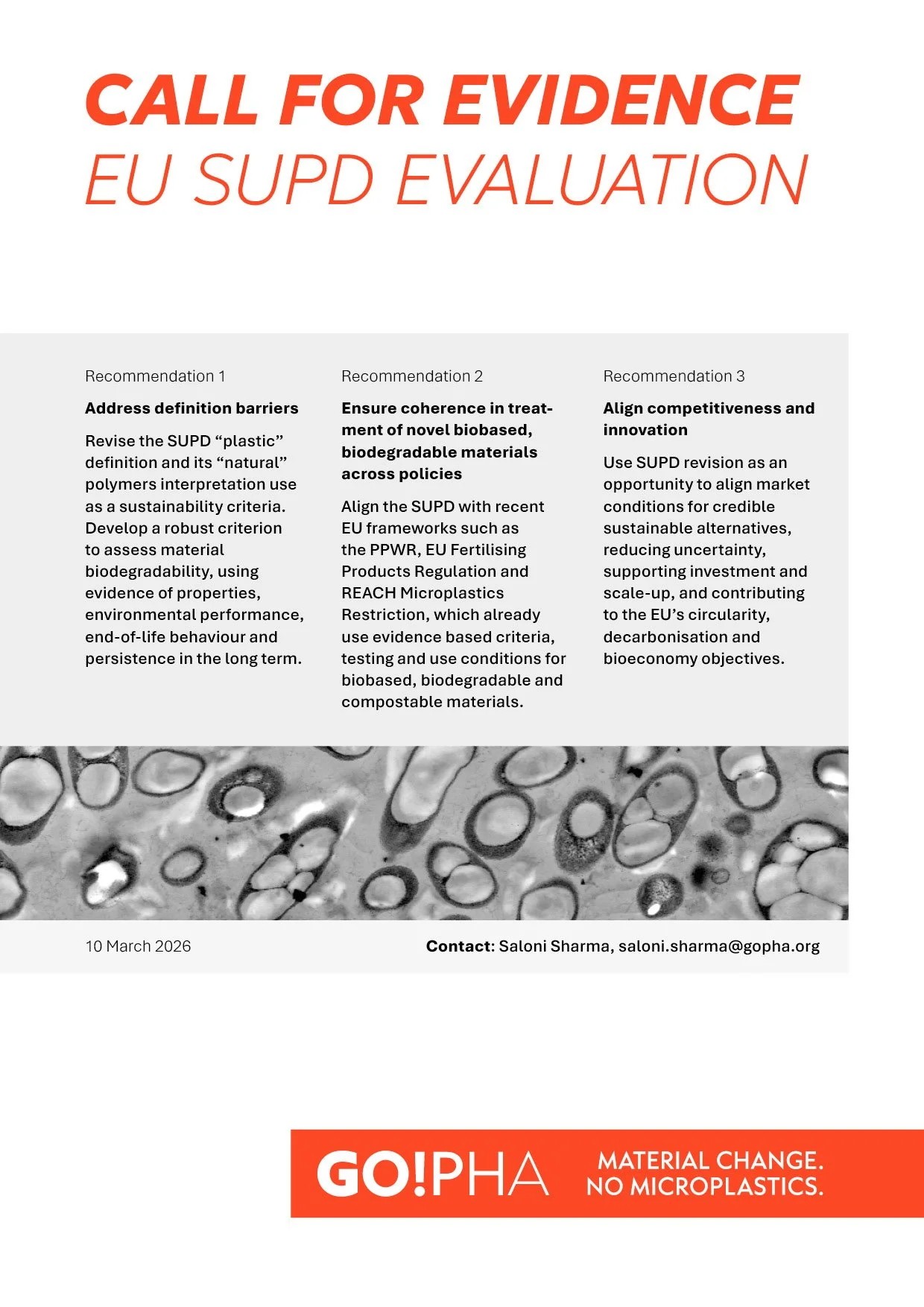
GO!PHA’s EU Single Use Plastics Directive (SUPD) evaluation
Submission to the EU call for evidence - March 2026
The submission highlights that the current SUPD framework does not sufficiently account for differences in material properties, biodegradability, and environmental persistence, resulting in bio-manufactured natural polymers being regulated in the same way as conventional plastics despite fundamentally different environmental characteristics. It also points to growing inconsistencies across EU legislation, as several newer frameworks already rely on scientific testing and performance-based criteria to assess biodegradable and bio-based materials. The submission therefore calls for a more science-based and coherent policy approach, recommending a revised interpretation of “natural polymers,” the adoption of criteria-based assessments focused on environmental performance rather than origin, and stronger alignment of the SUPD with broader EU circular economy and bioeconomy objectives.
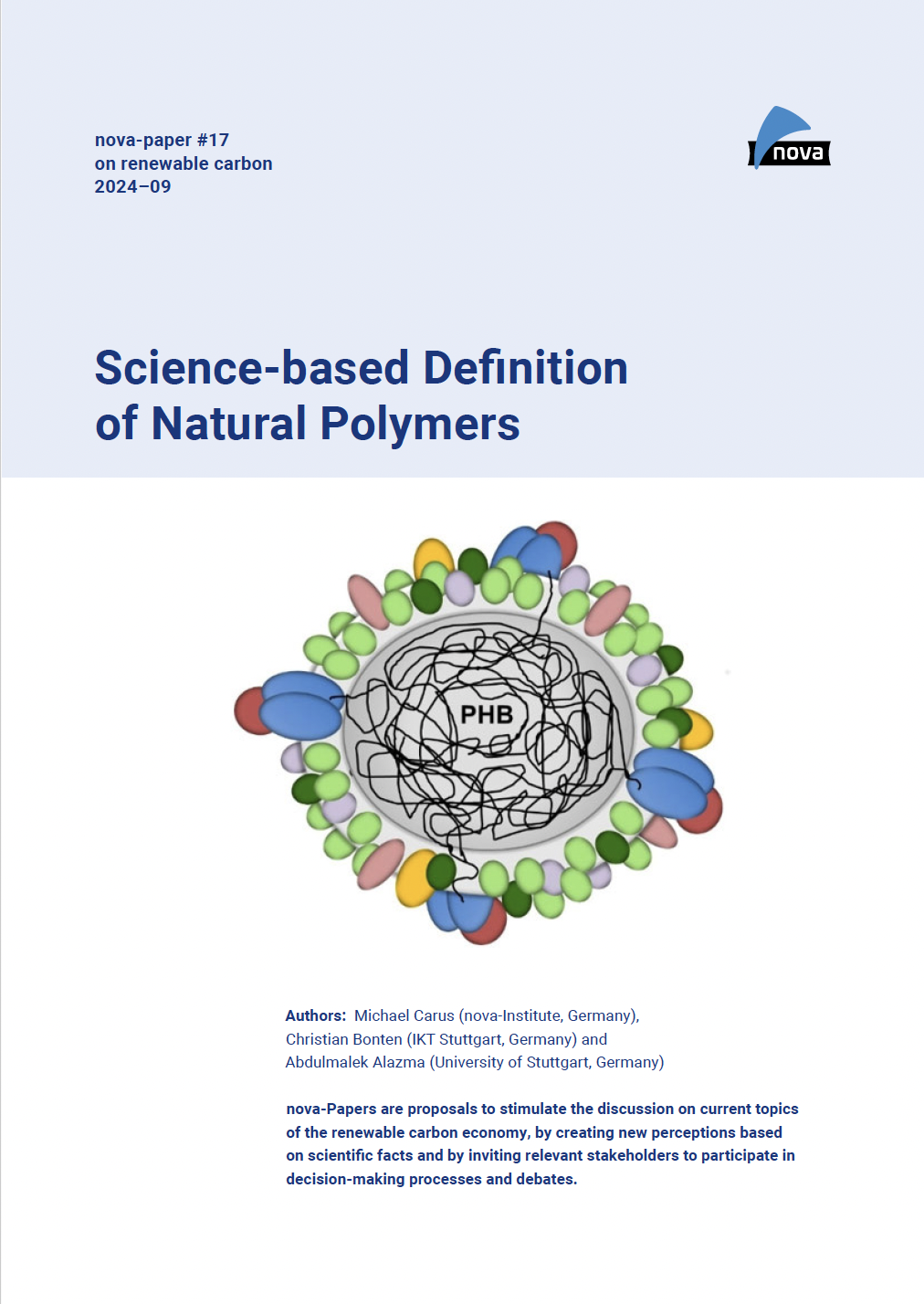
Science-based Definition of Natural Polymers
nova-Institut - September 2024
A science-based definition of natural polymers helps clarify how biologically produced materials used in nature and industry should be understood in policy and sustainability discussions. Natural polymers are macromolecules produced through biological processes and originate from four main biological sources: plants and algae, animals, fungi, and bacteria. These include widely used materials such as cellulose, starch, lignin and alginate from plants and algae; proteins such as collagen, keratin and silk from animals; chitin and chitosan from fungi and crustaceans; and bacterial polyesters such as polyhydroxyalkanoates (PHA). Polymers produced through biological processes such as industrial fermentation remain natural when they are chemically identical to those found in nature. Recognising this scientific understanding helps ensure that policy frameworks do not create unnecessary barriers to the development and adoption of innovative bio-based and biodegradable materials.
Which polymers are “natural polymers” in the sense of the single-use plastic ban?
nova-Institut - Open letter to DG Environment - September 2019
This open letter clarifies how “natural polymers” should be understood in the context of the EU Single-Use Plastics Directive. It explains that natural polymers includes those that are produced through biological processes such as biosynthesis or fermentation and groups them into four main biological origins: animals, plants and algae, fungi, and bacteria. Across these groups, examples include polysaccharides (e.g., cellulose, alginate, chitin), proteins (e.g., collagen, keratin, silk), and other naturally occurring polymers such as lignin and polyhydroxyalkanoates (PHA). The document emphasises that polymers produced through biological processes, including controlled fermentation, should be considered natural when they are chemically identical to those occurring in nature. The position is supported by 18 professors and leading scientists, highlighting the scientific consensus that definitions of natural polymers should reflect biological origin and material properties rather than the location of production.